

In today’s hyper-competitive B2B landscape, marketing managers face the daunting challenge of cutting through the noise to reach high-value accounts. Enter the dynamic duo of Account-Based Marketing (ABM) and social selling – a powerful combination that’s revolutionizing how B2B companies engage with their most promising prospects.
The Challenge: Precision in a Crowded Market
B2B marketing managers are all too familiar with the struggle: limited resources, increasing competition, and the pressure to deliver measurable results. Traditional broad-based marketing approaches often fall short, resulting in wasted efforts and missed opportunities. This is where the precision of ABM, enhanced by the reach and personalization of social selling, comes into play.
The Potential Gains: Why ABM and Social Selling Matter
Before we dive into the details, let’s consider the potential gains of integrating social selling into your ABM strategy:
- Increased engagement with decision-makers
- Higher conversion rates and shorter sales cycles
- Improved ROI on marketing efforts
- Enhanced brand reputation and thought leadership
- Better alignment between sales and marketing teams
Understanding ABM and Social Selling
 Account-Based Marketing (ABM)
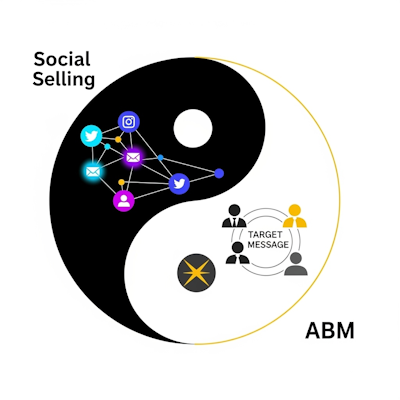 Account-Based Marketing (ABM)
ABM is a targeted approach that focuses on building personalized relationships with specific high-value accounts. Instead of casting a wide net, ABM allows you to concentrate your resources on the accounts most likely to convert and generate significant revenue.
Social Selling
Social selling leverages social media platforms to engage and connect with potential clients. It’s about building relationships, establishing trust, and positioning your brand as a valuable resource in your industry.
The Synergy: How Social Selling Amplifies ABM
- Precision Targeting Social media platforms provide rich data that can help you identify and understand key decision-makers within your target accounts. This information is invaluable for crafting personalized ABM campaigns.
- Relationship Building Social selling enables your team to engage with prospects on a more personal level. By sharing relevant content, participating in industry discussions, and offering valuable insights, you can establish trust and credibility long before the formal sales process begins.
- Content Customization By monitoring the social media activity of your target accounts, you can identify their pain points, interests, and challenges. This intelligence allows you to create highly targeted content that resonates with your audience and addresses their specific needs.
- Expanded Reach Social platforms allow you to extend your ABM efforts beyond direct outreach. Your content and interactions can be seen by others within the target organization, increasing your visibility and influence.
- Real-Time Engagement Social selling provides opportunities for timely interactions. When a target account shares news or asks a question, you can respond quickly, demonstrating your attentiveness and expertise.
- Leveraging Existing Relationships Encourage satisfied clients to share their experiences on social media. This social proof can be incredibly powerful in influencing other decision-makers within your target accounts.
Implementing the ABM-Social Selling Combo
- Identify Your Target Accounts Use data analytics to select high-value accounts that align with your ideal customer profile.
- Map the Decision-Making Unit Identify key stakeholders within each account and research their roles, interests, and social media presence.
- Develop Personalized Content Strategies Create content that addresses the specific challenges and goals of each target account.
- Engage Authentically on Social Platforms Train your team to engage in meaningful conversations, share valuable insights, and build relationships without being overly sales-focused.
- Align Sales and Marketing Efforts Ensure your sales and marketing teams are coordinated in their social selling efforts to present a unified message and approach.
- Monitor and Measure Use social listening tools and analytics to track engagement, sentiment, and the impact of your efforts on pipeline and revenue.
Conclusion: The Future of B2B Marketing
In an era where personalization and relationship-building are paramount, the combination of ABM and social selling offers B2B marketing managers a powerful toolkit for success. By focusing your efforts on high-value accounts and leveraging the relationship-building power of social media, you can create more meaningful connections, shorten sales cycles, and drive significant revenue growth.
Remember, the key to success lies in the thoughtful integration of these strategies. It’s not about abandoning traditional methods but enhancing them with the precision of ABM and the reach of social selling. As you implement this approach, you’ll likely find that your marketing efforts become more efficient, effective, and aligned with the needs of your most valuable prospects.
Are you ready to supercharge your B2B marketing strategy? Start by assessing your current ABM and social selling efforts, and identify opportunities to bring these powerful approaches together. The results may just transform your B2B marketing success.
Frequently Asked Questions
Small B2B companies can start by focusing on a handful of high-value target accounts and thoroughly researching their needs and challenges. Utilize free social media tools to engage with decision-makers, share relevant content, and participate in industry discussions. Leverage your team’s expertise to create valuable, targeted content. Start small, measure results, and gradually expand your efforts as you see success and gain more resources.
Key metrics include engagement rate on social posts targeting ABM accounts, number of meaningful interactions with decision-makers, increase in website visits from target accounts, growth in social media followers from ABM targets, shortened sales cycles, improved win rates for ABM accounts, and ultimately, increased revenue from these accounts. Track these metrics to gauge the effectiveness of your integrated ABM and social selling strategy.
Social selling in ABM focuses on building relationships through social media platforms before making a direct sales pitch. It involves sharing valuable content, engaging in meaningful conversations, and establishing trust with key decision-makers in target accounts. Unlike traditional sales, social selling emphasizes long-term relationship building and thought leadership, aligning perfectly with ABM’s personalized approach to high-value accounts.


