
The “SEO Is Dead” Funeral Is Premature

The digital marketing world loves a good funeral. Every few years, a new technology arrives and the eulogies for search engine optimization start circulating. Social media was supposed to kill it. Mobile was supposed to kill it. Voice search was definitely supposed to kill it. Now the mourners have gathered again, this time around generative AI.
To be fair, this challenger is the most formidable one yet. Google’s AI Overviews, ChatGPT, and Perplexity now answer buyer questions directly, synthesizing information from multiple sources into a single response. Your prospect asks, the machine answers, and in many cases nobody clicks anything. If the answer arrives before the website visit, the logic goes, why keep investing in the blue links?
Here’s the problem with that logic: it misunderstands where the AI’s answer comes from. The industry has handed us two new acronyms to chase: Answer Engine Optimization (AEO) and Generative Engine Optimization (GEO). Neither one is a replacement for SEO. Both are built on top of it. The same fundamentals that have always determined search visibility (crawlability, authority, and structured data) now determine whether the large language models behind these platforms can find your brand, trust it, and cite it.
SEO isn’t dying. It’s getting promoted. And the B2B brands that abandon it now to “wait and see” on GEO are handing their competitors the AI conversation.
What GEO Actually Is, and Where SEO Fits In

For two decades, search worked like a reference desk. A buyer typed a query, the engine returned a ranked list of links, and the buyer did the work of clicking, reading, and comparing. Your job was to land on that list, as high as possible.
Generative engines flip the model. Instead of handing the buyer a list, they hand over an answer: a synthesized summary pulled from multiple sources, often with a handful of citations attached. The buyer gets the conclusion first and the sources second, if they look at the sources at all.
This is where the acronyms earn their keep. AEO is about making your content the answer: structuring pages so a search engine, voice assistant, or AI Overview can lift a clear, direct response to a specific question. GEO goes a step further, earning your brand a mention or citation when a generative engine synthesizes an answer from multiple sources. Put simply, SEO gets you found, AEO makes you quotable, and GEO gets you cited. Each layer depends on the one beneath it.
So where does that answer come from? Many people assume the AI simply “knows” things from its training. That’s only partly true. Training data goes stale, and models working from memory alone can confidently invent details, the infamous hallucination problem. To stay accurate and current, AI search platforms rely on a process called Retrieval-Augmented Generation, or RAG.
Here’s the non-technical version. Picture the AI as a sharp research analyst who has been told never to answer from memory. When a question comes in, the analyst first runs a search, pulls the most relevant and credible documents, reads them, and then writes a response grounded in what they found. Retrieval comes first. Generation comes second.
That retrieval step is where SEO lives. The AI’s research analyst isn’t wandering the internet at random. It relies on search indexes and crawled content, and it favors sources that are accessible, clearly structured, and credible. In other words, the pages that win in traditional search are the ones most likely to land in the AI’s reading pile. If your content never makes the retrieval cut, it never makes the answer.
The Three Pillars GEO Borrows From SEO

If GEO is the answer layer, SEO is the foundation underneath it. Three pillars carry most of the weight.
Pillar One: Authority and Trust
AI platforms have every incentive to be choosy about their sources. A model that confidently recommends the wrong vendor, cites a bogus statistic, or repeats misinformation damages the platform’s own credibility. These systems are designed to lean on sources that look trustworthy.
How does a machine decide what looks trustworthy? Largely through the same signals Google has rewarded for years under its E-E-A-T framework: Experience, Expertise, Authoritativeness, and Trustworthiness. Quality backlinks from respected industry sites. Consistent brand mentions across publications, directories, and review platforms. Named authors with real credentials and bios that prove a human expert stands behind the content.
None of those signals are new. They’re the core of a disciplined SEO program. What’s changed is the stakes. In traditional search, weak authority meant ranking on page three. In generative search, there is no page three. There’s the answer and the short list of sources it cites. If you haven’t earned authority through SEO, the AI has no reason to put your name on that list.
Pillar Two: Structured Data, the Native Language of AI
AI models are remarkably capable readers, but they still benefit from being told exactly what they’re looking at. That’s the job of structured data: Schema.org vocabulary, typically implemented as JSON-LD code on your pages.
Schema labels the entities on your site and the relationships between them. This is our company. This is our founder. This is a service we offer, the industry we serve, a review from a client. Without those labels, a machine has to infer relationships from context. With them, it can read your brand’s story with confidence. Search engines use these signals to build their knowledge graphs, the interconnected maps of entities and facts that shape how they understand and describe a brand.
Schema has long been filed under “technical SEO,” the kind of task that drifts to the bottom of the backlog. That filing system is now a liability. When you stop providing clear labels, you leave the interpretation of your brand up to the AI, and the AI will happily fill the gaps with a competitor who did the work. Machine-readable brands are citable brands.
Pillar Three: Content Depth and Intent
Generative engines are built to answer the hard questions: the “why” and “how” queries that used to require reading three articles and a white paper. They gravitate toward content that actually explains things, organized clearly and focused on what the buyer is genuinely trying to figure out.
SEO already made this transition. Keyword stuffing gave way to topic clusters: a pillar page that covers a core subject in depth, supported by a network of interlinked articles that each tackle a subtopic thoroughly. Topic clusters were designed to prove topical authority to search engines. As it turns out, they’re exactly what a large language model needs to understand that your brand doesn’t just mention a subject. It owns it.
One article on a topic makes you a participant. A connected body of work makes you the source.
The Feedback Loop: How SEO Feeds the Machine
The relationship between SEO and GEO isn’t a one-time handoff. It’s a continuous loop, and it runs through three stages.
It starts with discovery. AI platforms send their own crawlers across the web, much like traditional search spiders: OpenAI’s GPTBot and OAI-SearchBot, PerplexityBot, and Googlebot, which feeds the index behind AI Overviews. These bots need what every crawler has always needed: pages they’re allowed to access, an architecture they can navigate, and content that loads and renders reliably. A misconfigured robots.txt file or a site riddled with crawl errors doesn’t just hurt your rankings anymore. It can lock you out of the AI conversation entirely.
Next come the citations. Generative answers frequently cite their sources, and those citations aren’t handed out at random. There’s a strong overlap between pages that perform in traditional search and pages that appear in AI-generated responses, because the retrieval step draws on many of the same signals. Every citation also strengthens your brand’s association with the topic, which makes the next citation more likely. Authority compounds.
Finally, there’s the brand moat. When an AI system describes your company, it assembles that description from whatever it can find. If the most authoritative, best-structured information about your brand lives on your own site and in reputable third-party coverage, that’s the narrative the AI repeats. If it doesn’t, the machine fills the gap with an outdated directory listing, a competitor’s comparison page, or a stray forum thread. SEO is how you make sure the AI tells your story, not someone else’s version of it.
Harmonizing SEO and GEO: Where to Put Your Effort

Here’s the good news for B2B marketing leaders: you don’t need to build a separate GEO program from scratch. You need to aim your SEO program at the new target. Three moves make the biggest difference.
Engineer your brand citations. AI answers to commercial questions, such as the best managed IT providers for mid-size firms or the top engineering consultancies for federal projects, lean heavily on third-party lists, reviews, and industry roundups. That makes digital PR, review generation, and placement in reputable “best of” lists a GEO priority, not just a link-building tactic. If your brand isn’t mentioned where the AI does its research, it won’t be mentioned in the answer.
Write for the questions buyers actually ask. Expand keyword research beyond short-tail terms into the natural-language questions buyers type and speak into AI tools. Old SEO chased “cybersecurity compliance consulting.” New SEO answers “What does a mid-size defense contractor need to do to prepare for a CMMC assessment, and how long will it take?” Build content that answers those questions directly and early, with clear headings, a concise answer up front, and real depth underneath. This is AEO in practice, and it’s the bridge between ranking and being cited. FAQ sections built from actual sales conversations are an easy place to start.
Fix the plumbing. Site speed, mobile performance, clean architecture, logical internal linking, and crawl access are the unglamorous work that determines whether AI scouts can reach your content at all. Audit your robots.txt to confirm you aren’t unintentionally blocking the AI crawlers you want, and make sure critical content isn’t buried behind scripts or gated forms that bots can’t get past. A slow, tangled site isn’t just a poor user experience. To a generative engine, it’s an empty room.
The New Search Reality
Here’s the bottom line: AEO and GEO are SEO with a new interface. The buyer sees a conversational answer instead of ten blue links, but underneath that answer sits the same machinery: crawling, indexing, authority signals, structured data, and content that genuinely satisfies intent.
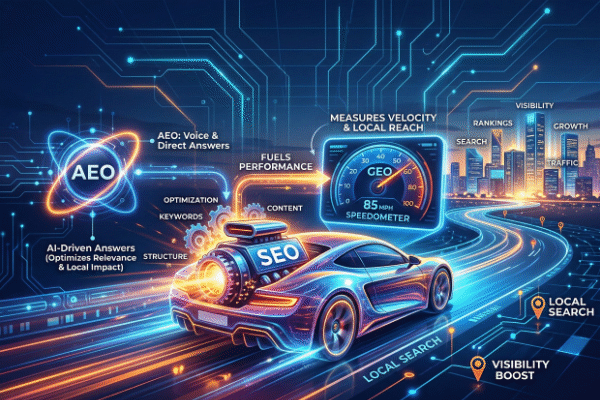
Think of it this way. SEO is the engine. GEO is the speedometer on the dashboard, the visible readout of how much power you’ve built. You can stare at the gauge all day, but the needle only moves when the engine is running.
Brands that pause SEO to “wait for GEO to mature” are making an expensive bet. While they wait, their competitors are building the authority, structure, and depth that AI systems draw on when deciding which vendors to mention. By the time the waiting brands re-engage, the AI will already have learned who the experts are, and it won’t be them.
If you want the AI to talk about your brand, you have to give it something worth reading and a clear path to find it. That path is SEO. Invest in it today, and you become the answer the AI gives tomorrow.
Frequently Asked Questions
Start by asking the questions your buyers ask in ChatGPT, Perplexity, and Google, then note whether your brand appears and how it’s described. For ongoing tracking, several SEO platforms now offer AI visibility reporting that monitors brand mentions and citations across generative engines. Pair those findings with a technical SEO audit to pinpoint the gaps holding your visibility back.
Think of them as layers. SEO earns visibility in traditional search results. AEO (Answer Engine Optimization) structures content so search engines, voice assistants, and AI Overviews can pull a direct answer from it. GEO (Generative Engine Optimization) earns mentions and citations when AI platforms synthesize answers from multiple sources. All three share the same foundation: technical health, authority signals, structured data, and in-depth content.
Yes, arguably more than ever. AI platforms like Google’s AI Overviews, ChatGPT, and Perplexity retrieve information from the web before generating answers, and they favor sources that are crawlable, authoritative, and well-structured. Those are SEO outcomes. Cutting SEO investment doesn’t redirect you toward GEO; it removes you from the pool of sources the AI draws from.
Is your brand part of the AI conversation, or missing from it?
MarCom 24/7 helps B2B and B2G organizations build the SEO foundation generative engines rely on, from technical audits and structured data to authority-building content strategies. Let’s find out what the AI is saying about you, and make sure it’s saying the right things.
Contact MarCom 24/7 to schedule your consultation and see how our SEO, AEO, and GEO services can make your brand the answer AI gives.


